The turnpike road from the Devil's Bridge to Aberiftwid is
over a ridge of hills, exhibiting a general view of the vale, as the
road by the Rydoll unfolds the fcenery in detail. The village of
Efkynald excepted, there is little appearance of an inhabited
country. About three miles from Aberiftwid, there is a fine fea
view, agreeably broken by a promontory in front of the road.
Other picturefque circumftances might be mentioned; but I
haften to the defcription of Aberiftwid, which we approached by
a turnpike gate, where arc a few houfes, known by the name of
Piccadilly.
The building of the caftle is thus related. King Henry the
Firft, about the year 1109, told Gilbert Strongbow, that as he
had frequently petitioned to obtain fome lands in Wales, he might
now win and poffefs the lands and inheritance of Cadwgan ap
Blethin. Gilbert immediately collected his forces, and having
landed in Cardiganfhire, reduced the country to fubjecion with
little difficulty. He then built two caftles; one in the direction
of Pembrbkefhire, perhaps at Kilgerran, and the other at this place,
on I the river Rydoll, one mile from Lan Padern. It was of
courfe the policy of this intruder, to embroil the native proprietors
with,the King of England, that his own houfe might be aggrandized
by conquefts and confifcations. About the year 1111,
Gruffyth ap Rees came over from Ireland, where he had been
brought up from his childhood. He had not refided more than
two years in his native country, before he was accufed of aiming
at the fovereignty of South Wales. King Henry made feveral
attempts to poffefs his perfon; but the vigilance of his friends
defeated every confpiracy. In the courfe of time, he was enabled
to act on the offenfive. After many other bold and fuccefsful
feats, in the year 1116, he encamped near the fortified manfion
on the banks of the Rydol, between Aberiftwid and the town of
Lan Padern, with the intention of laying fiege to the caftle of
Aberiftwid on the following day. But a reinforcement from a caftle
in the neighbourhood, with a fuperiority of military ftratagems on
the part of the enemy, converted the aggreffion of the Welfh into a
defeat. Prince Gruffyth ap Rees fought with better fortune in the
year 1135; for he took and razed the caftle of Aberiftwid, and
flew the Normans and Saxons that were fettled in Cardiganfhire.
Some of thofe who efcaped fled over the fea to England.
Gruffyth reftored to the Welfh their lands and habitations, of
which they had been deprived. Others of the Normans and Saxons
retreated with lefs precipitation from Gruffyth ap Rees; but they
were unexpectedly attacked, near the vale of Neath in Glamorganfhire, by the fons of Caradoc ap Jeftin, who flew more than
three thouland of them, and put the reft to flight. Some of
them efcaped into Gower, where they found proteftion in the
caftles, that had been erected there by Henry Beaumont. This
caftle was reinftated by Cadwallader, fecond fon to Gruffyth ap
Conan, and again deftroyed by Owen Gwineth, the eldeft fon and
fucceffor, on account of his brother's contumacy. It continued
to experience all the viciflitudes of a predatory warfare, alternately
fortified and overthrown. Such fortifications, as were then in ufe
were indeed eafily demoliflied; but in the courfe of time it
owned a more powerful mafter, though even his formidable provisons were not effectual againft the defperate enthufiafm of
expiring liberty. King Edward the Firft rebuilt it in the year
1277, and returned to England in high triumph. But the
oppreffions exercifed by the rulers of the Marches did not permit
the peace concluded between the Prince of Wales and the King
of England to continue. Among the brief fuccefles of the Welfh,
the year before their fubjction was fealed, is to be numbered the
fplendid capture of this newly erected Englifh fortrefs. Many
other caftles were taken in that diftrict, and the partifans of
foreign domination were grievoufly haraffed throughout the
country. This caftle, in the year 1404, was taken by Owen
Glandwr, during one of his molt vigorous campaigns. The
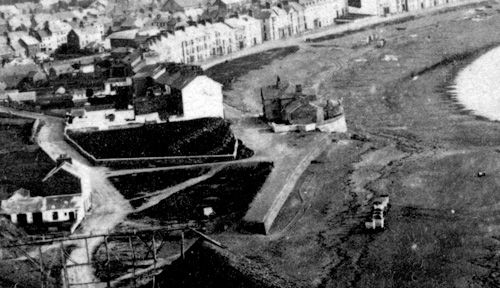
embattled houfe before mentioned, which now forms an interefting ruin, is reported to have been one of his refidences. What
was the origin of this caftellated manlion, does not appear; but
we have already feen that it muft be nearly coeval with the firft
foundation of the neighbouring caftle; and one of the barda teftifies
it to have been inhabited by the native princes. The common
ftory prevails, of a fubterraneous communication with the caftle
on the one hand, and the fanctuary of St. Padern on the other.
The original extent may eafily be traced, and one of the towers is,
nearly perfect. The apartments have evidently been numerous,
and on a large fcale. The eftate now forms a part of Nanteos.
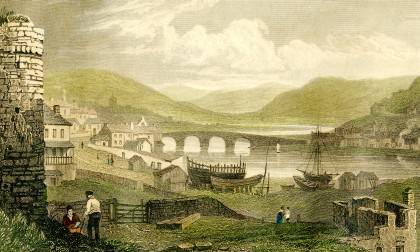
The caftle ftands at the extremity of the town, overlooking a wide
expanfe of fea. Little of it remains, except a folitary tower,
lofty and weather beaten, which, with the ruin on the bank of
the river, gives a pidurefque and dignified air to the approach.
The town, though generally reprefented in the tours and direc-
tories afr irregular and dirty, appeared to me rather above than below
below the level of Welch towns in general. It is much frequented
as a bathing place, efpecially by Shropfhire and Herefordfhire
families. The coaft is grand, and the marine profpect particularly
fine. The rocks are lofty, black, and excavated; the layers of flate
in general dip downwards, and the cliffs are in every refpect of
an oppofite charafter to thofe of limeftone, which linethe coaft
of Pertibrokefhire and Glamorganfhire. The harbour is fufficiently
comrriodiaus for the utmoft extent of trade, of which the place,
from its fituation, is capable. That, indeed, is not inconfiderable;
for lead, calamine, and oak-bark, are exported in fome quantity,
as well as a few manufactured goods to Briftol and Liverpool.
Should the north of Cardiganfhire ever rife into a ftate of high improvement, the poflibility of which recent experience can atteft, no
dlfcouragement can be fuppofed to operate againft its interefts from
want of a market, fince the intercourfe with large towns, and efpecially Liverpool, muft always be ready and advantageous from this
port. But the town was in the plenitude of its importance, when
the mines were worked to the immenfe profit which has been
fet forth in the preceding chapter. The gratitude of Mr. Bufhel
has already been recorded; the fpirit of the people was equally on
the fide of royalty; and the caftle, though now a mere fragment,
was even at that late period tenable for fome time, againft the
forces of the parliament. It is a circumftance not altogether to
be difregarded, that the town appears to have been mifnamed; as
it really ftands on the northern bank of the Rydoll. Juft below
the town, the two rivers mingle their waters with the ocean,
nearly at the fame place.