1700-mid 1800's
Common Land
Over the next 150 years the system of 'open fields' and common grazing is slowly replaced by fenced in fields.
Over the next 150 years the system of 'open fields' and common grazing is slowly replaced by fenced in fields.
Britain hit by a storm. (Regarded by many as the most powerful to hit Britain in recoded history). Many thousands of lives lost and over 150 ships sunk. Worst hit are are south of England and Wales
(cf Storms in 1866, 1887, 1896, 1910, 1927, 1938, 1987, 2002 and 2014)Edmond Halley discovers and path of the comet that's now named after him
William Jones of Anglesey published Synopsis Palmariorum Matheseos (New Introduction to the Mathematics) in which he first introduced the symbol π for the ratio of the circumference of any circle to its diameter.
United Kingdom established by the union of the English and Scottish Parliaments
1st Practical steam engine devised by Thomas Newcomen in Devon, England
Mercury thermometer invented by Gabriel Fahrenheit. (cf themomoscope 240BC and 100° 1742)
1st European 'Stock Market' crash - The South Sea Bubble
On Aberystwyth: a populous but very dirty, black, smoky place
On its people: looked as if they lived continually in the coal or lead mines
Daniel Defoe[18]
The Gogerddan Arms was built around 1727 on the corner of Bridge St and Greatdarkgate St. It has been -> New Black Lion(?) -> by 1835: Lion Royal Hotel -> Padarn Hall (University's student residence), and was turned into shops and offices in 1990.
We present all such psons as put their Dung into the oppen Street to ye Annoyance and disturbance of the publick within this Corporation.
Act of Parliament decrees that the English language replaces Latin on official documents so that "the common people might have knowledge and understanding of what was alleged or done for and against them"
Steam engine used to pump water out of deep mines where iron rails are used to push carts through the mine. (These were put together in 1803 to form the Locomotive)
Near-by Nanteos Mansion built by the Powell family.
We present That if any person for the future shell undermine, dull down and Carry away the Stones of the Towers or Castle Walls Shall be obliged to pay five pounds
Harsh winter followed by famine in Ireland
The Windmill by the side of Pier Street is moved out of the centre of town to a spot behind Tan y Bwlch Beach.[4]
We present all such Inhabitants who lay downe their dunghill opposite their doors the same being a Common Nusaince
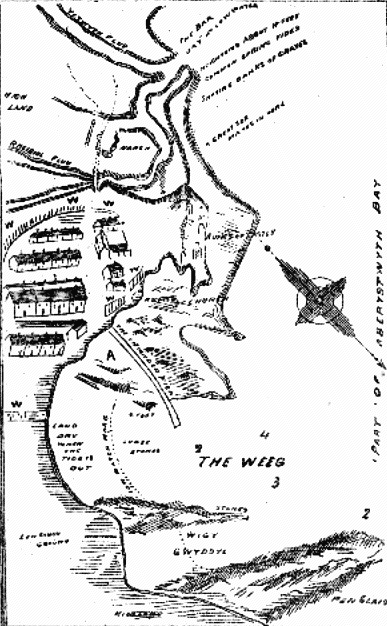
In this year a member of the Pryce family was elected. It will be 1868 before an Aberystwyth election is won by someone who was not a member of the Pryce family or owes allegiance to them.
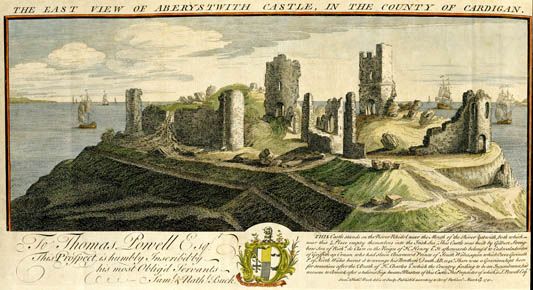
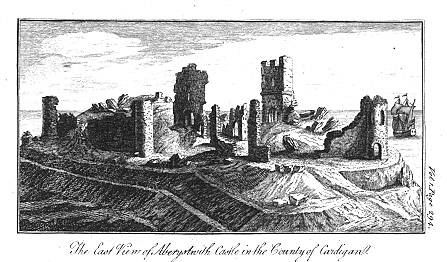
Although their main work of over 400 prints was first published under the title of 'A Collection of Engravings of Castles, Abbeys and Towns in England and Wales' in 1741, Samuel and Nathaniel Buck had started making sketches and these prints as early as 1726.
Work on the castle at this site was started in 1277, so references to castles prior to this date would be to other castle sites in this area
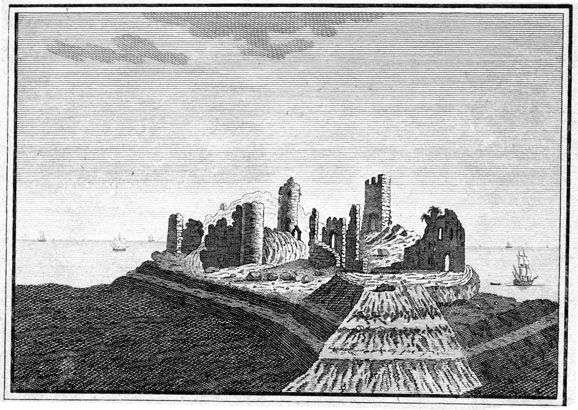
This print is based on the one by the Buck brothers
Engraved by John Eastgate 1786-1819
Republished by Alexander Hogg many times in the late 1700's
1st edition of 'The Antiquities of England & Wales' was published around 1786
Swedish astronomer Anders Celsius devises a scale of temperature that has 100 steps between the boiling point and the freezing point of water (cf themomoscope 240BC and Mercury thermometer 1714)
In 1743 fresh trouble arose concerning the Mill in consequence of some inhabitants taking corn to mills outside the town. An action was commenced to determine the question whether grinding elsewhere was an infringement of the rights attached to 'Our Lady's Mill' The difficulty was removed by the Corporation granting a plot of land for the purpose of enlarging the mill and making it sufficient to meet te requirements of the town.[16]
Llywernog mine set up. Silver-lead mining was the major industry in north Cardiganshire for hundreds of years with enormous amounts of capital coming into the area - equivalent to a billion pounds of investment by modern rates. Aber' eventually had four Iron Foundries making mining machinery and a commercial port which exported ore. Many of the mining companies maintained offices in Aber' and the landed gentry of Cardiganshire (more particularly the Powells of Nanteos, Lisburnes of Trawscoed and Pryses of Gogerddan) made fortunes from mining royalties and water rights for wheels.
The mine is now open as a museum.
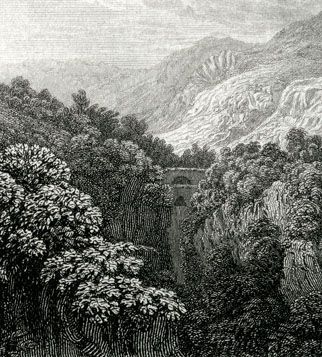
With the improving roads, the stone 'Devil's Bridge' built around 600 years earlier is deemed ready for an upgrade so a new one is built directly above the first one. The 3rd bridge will be built in 1901.
We present all such Inhabitants of Dark Gate Street, Bridge Street Castle Street, and Weeg Street within this Town for throwing Dirt and Ashes over agst their Houses, and having Dunghills in their streets.
In a letter written to his brother, about the year 1757, he [Mr Lewis Morris (born 1701 Anglesey - 1765) , antiquary who worked many of the Cardiganshire Mines] speaks of Cardiganshire as the richest country he ever knew, with the fewest people of ingenuity and talent[15]
Start of the Industrial Revolution
Certain parts of the town walls, which were then dangerous, were ordered to be removed, but portions remained for a further period of 50 years.[16]
One of the 1st banks in Wales was opened in Bridge St. Named the 'Aberystwith & Cardiganshire Bank' it was popularly know as 'Bank y Llong' or 'The Ship Bank' because of ships illustrated on its bank notes and because it served the growing maritime trade of the harbour at the bottom of the street.
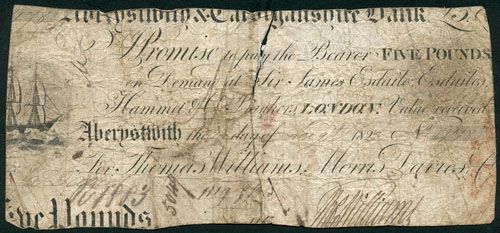
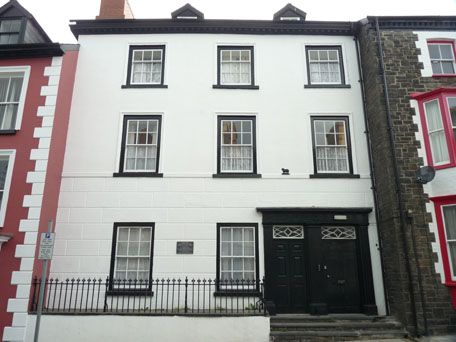
To this day the building where it started is called . . . . 'The Old Bank House'
Previously, ships where not allowed to sail out of Aberystwyth without the permission of the area Customs House which was down the coast at Aberdovey. Local mine owners and business men petitioned and got the Customs House moved to Aberystwyth. It was built at the junction of Pier Street and King Street allowing the port to flourish. Shipbuilding, fishing and transportation of minerals allow the town to grow.[15]
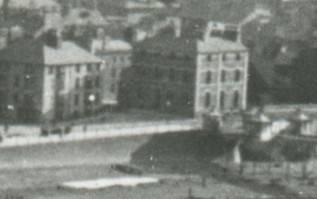
Population about 1,400
Aberystwyth was established as a post-town. Previously post for Aberystwyth was sent to Montgomery. Mary Harris was appointed postmaster her post office was 'adjoining the St Michael's churchyard wall' The 1st regular collection and delivery of letters was just once a week. Postage rates were dependant on the distance the letter travelled and sometimes even the route taken.
Famine in British East India Company controlled Bengal causes 10 million deaths ie ¼ of the population.
The town hall of 1690 was built of Lath and plaster and needed regular repair. By 1770 it had become so 'ruinous and out of repair' that it was decided to build a new town hall on the same site.
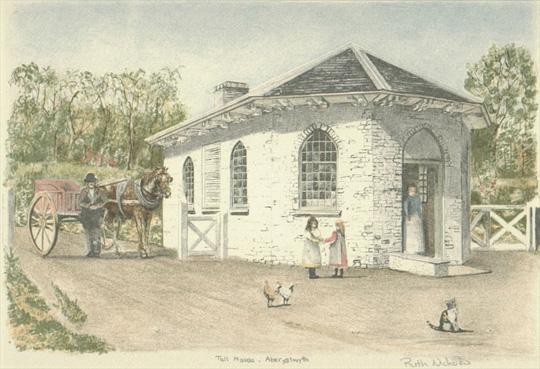
Act of Parliament allowed members of the local gentry to collect tolls from the users of roads. These tolls where to be used for the improvement and maintenance of the roads.
Tollgate built at Southgate (2km East of Aberystwyth) to control the junction of five roads on the southern approach to Aberystwyth. This was dismantled in 1960 and rebuilt at the Welsh Folk museum in St Fagons.
We present every Inhabitant of this Town that shall throw any Dirt Stones Rubbish or Ashes into the Streets and shall leave them there for above the Space of Twenty four Hours to be fined five Shillings to be leavied by the Mayor for the use and Benefit of the Corporation.
the town of Aberustwith (sic) at the time was a seat of ignorance and vice. It had no place of worship, the parish church being about two miles distant A chapel of ease was erected when I was a child, but the bishop refused to consecrate it for many years. Such were the ignorance and prejudice of the leading men in the town that very few preachers were permitted to enter it. I remember seeing the ringleaders in the service of Satan pelting a preacher with dirt, because he preached unto them Christ and his salvation. But notwithstanding their persecuting spirit, their reviling on the Sabbath and all manner of other vices, God was pleased to spare the town, and gradually to introduce the Gospel into it. There are now (1818), even at Aberustwith five places of worship, well attended, and a Bible society.
A small spring was discovered (by the bus station on the junction of Alexandra rd and Plascrug Avenue). Chalybeate, (meaning containing iron salts) spring waters where a popular 'tonic' at this time.
THE PROPERTIES, &c. OF THE CHALYBEATE SPRING.
Although favoured by a medical gentleman of the town, with a scientific analysis of this spa, we consider a plain statement of its properties, divested of the abstruse phraseology of science, more serviceable to general readers, and therefore present them with the following brief account. This water resembles the chalybeate springs both of Tunbridge and Llandrindod Wells, equally pellucid and as strongly impregnated. It is simply chalybeate, neither acidulous or saline to the taste, except when it has been mixed with the sea water, after high tides; nor is there any sulphur in it. The spirits are excited and the appetite improved by a perseverance in its use; and in a variety of disorders where steel may be required, it will prove of great service. It is recommended to be drank at eight o'clock in the morning, and again between breakfast and dinner; gradually increasing the dose according to age or habit. As the bowels should be attended to in commencing a course of the chalybeate spa, a glass of sea water or any aperient physic may he taken previously.
Aberystwyth gets Act of Parliament to improve harbour
St David's Club Gentlemen's Society formed (downsized into a snooker club in 2016)
Beginnings of Aberystwyth's tourist trade with the 1st regular stagecoach service for Aberystwyth. The coach took the route from Aberystwyth via Devil's Bridge on to Eisteddfa Gurig and then to Shrewsbury.
William Herschel announced the discovery of a new planet which became known as Uranus
British Courts rule that the captain of the British slave ship Zong could not claim insurance for jettisoning 133 ill slaves.
The war between America and Britain formally ends when America's Independence is recognized by the Treaty of Paris
Raging for 8 months the Laki volcano (Iceland) was the largest 'high latitude' volcano in over 1000 years. The poisonous gas cloud slowly killed many thousands all over Europe and caused a Famine In Egypt and a deep winter in America.
In Britain, the thick, dry, acidic fog that lasted much of the summer killed many thousands by destroying their lungs. The winter of 1783/4 was both much colder and much longer than normal.
By this time Aberystwyth had become a fashionable watering place for visiting gentry. Slowly the town started to clean up the streets and make improvement to suit the refined tastes of the moneyed 'quality' as the gentry were know. Around this time small troupes of actors started visiting to put on shows for the tourists.
Consecration of the Chapel of St Michael which could hold 350
With towns & cities being increasingly polluted Aberystwyth comes into fashion as a place to take fresh air and recuperate. But at this time the endeavour was not for the faint-hearted.... Thirty four year old Catherine Hutton of Birmingham accompanied her ailing mother to Aberystwyth for the summer of 1787. The following are excepts of letters from Catherine to her brother.
Aberystwith, July, 1787
Our arrival here is announced at the top of my paper, but you will expect some account of our journey Through Kidderminster, Bewdley, and Cleobury, we reached the foot of the Clee Hills, and a steep and rugged ascent brought us to the summit, which presented to our view a rich plain, bounded by high and distant hills, with Ludlow seated on a small hill in the centre. We visited its ancient castle, and then pursued our journey. After proceeding some miles along the vale, we mounted one of the hills which formed its boundary, and then toiled up another, and another. Day was closing, when we saw not a human creature. Night succeeded ; the rains descended and the winds blew, and most acceptable were the lights of the town of Bishop's Castle, when we saw them at some distance before us. At the inn here our floor was of brick, and our fire was to be lighted ; our supper was a pint of sherry made into a posset, and our beds were as hard as the floors of the rooms we occupied.
From Bishop's Castle we travelled again over high hills ; but we had a most beautiful vale, the vale of Montgomery, on our right. At four miles we crossed Offa's Dyke, and for the first time entered Wales. At nine miles we came to the town of Montgomery ; but instead of passing through it, as we expected, our post-boy turned to the left, up a road as steep as a reasonable roof of a house. If the chaise had broken down, our necks might also have been broken by our rolling down to the roofs and chimneys of the houses of Montgomery. We soon found there was no other motive for mounting this hill than that we might get down again, which we did by running our horses' noses, first into the hedge on one side and then on the other, till our descent was completed, and we arrived at the banks of the Severn.
We travelled by the side of the river to Newtown, where the master of the inn informed us that we were forty-three miles from Aberystwith ; that neither chaise nor horses were to be had between the two places, and that he could not convey us without four horses.
My father agreed to what he could not possibly dispute, and after waiting long for the assembling of the different parts of which our equipage was composed, it drove to the door. The horses were of different colours, from white to black ; and of different sizes, from that of a common horse to a pony. The drivers, for post-boys they could not be called, not driving post, were, one a farming man of forty years of age ; the other, the innkeeper's son, of thirteen. Our road to Llanidloes followed the course of the Severn, and verdant hills rose so near us on every side that it was difficult to imagine by which way we could escape from them.
Our inn at Llanidloes was built with brick, so was a house belonging to 'a squire of five hundred a year,' who dwells in the town ; the rest were raised and covered with planks. We sauntered to the churchyard and saw the graves covered with wicker work, or neatly paved with small stones. We strolled down to a rude wooden bridge over the Severn, and, as we were only five miles from its source, we endeavoured, but in vain, to catch a view of Plinlimmon.
Strangers, like ourselves, attracted all eyes ; and among others the eyes of a man in a fustian coat, who did not appear as if, like the rest, he gained his bread by the labour of his hands. This man looked at me with so much attention that I fancied we might meet him the next day with a pistol in his hand, and I took especial care to avoid mentioning in his hearing the road we intended to go. On my return to the inn I described him to Miss Parry, the daughter, who waited upon us ; and I added, ' This man looks as if he had no visible means of subsistence.' ' Oh, no,' she replied, ' he is a gentleman, with an estate of two hundred pounds a year.'
In the evening, with the hill above Montgomery full in my remembrance, and the knowledge that four horses were necessary for the hills before us, I went into the kitchen and asked Mr. Parry if anybody ever came back alive from Aberystwith. He said there were some ' fou bonks,' to be sure, but that people did come back alive ; and our head coachman comforted us still further by observing that he had several times, generally once or twice a year, taken people thither in safety.
Our road the next morning was so narrow that our carriage exactly filled it, but there was not the smallest danger of meeting another. To this succeeded open sheep pastures without a track, and at four miles we came to the village of Llangerrig and the River Wye. For five miles we followed the course of the river, between two ranges of hills which afforded pasture for numerous flocks, and from the hollows of which descended a thousand mountain torrents. Our road was formed on the range to the right, at such a height above the river as not to be frightful, though quite sufficient to dash us to pieces if we had fallen down the precipice. In most places a horse might have passed us if we had met any such animal ; I saw one place where I thought a cat must have climbed the mountain or dived into the river to have done so. There was in no place any fence to impede the latter means of escaping. At nine miles from Llanidloes we crossed the Wye and left it, my mother and I choosing to walk over a bridge made of two planks rather than drive through the stream. After passing woods and bogs, and driving up the stony channel of a brook, we entered Cardiganshire, and at seventeen miles we arrived at the village of Yspytty Ystwith, where stands one of its inns.
Till lately the inn at Yspytty afforded little entertainment for man or horse ; it now affords oats as well as hay for the latter ; the former still bring their provisions with them. Not that the innkeeper and his family do not eat, but they eat such food as is not agreeable to travellers. The ground floor of the inn consists of one habitable room, and one for lumber. A fire was blazing on the hearth of the former, and over it was stewing the family dinner, which was composed of cabbages, turnips, and carrots. The only servant, a labouring man, was, in the meantime, eating a bowlful of vegetable broth. The grand ornament of the room was a piece of bacon suspended from a beam ; and a morsel of this, occasionally, made a feast. The hostess desired our coachman to bring her a piece of beef, if he should come up to Aberystwith again this summer. That he will not I believe, and the family will go without beef at least another year, The upper part of the dwelling consisted of one room only, to which I mounted by a ladder, and which I entered by a small aperture left in the floor. This aperture conveyed all the light and air permitted to enter the apartment ; for window and chimney it had none. It had, however, three beds, one for the master and mistress of the house, one for their servant, and one for the accommodation of any traveller who might be so unfortunate as to be obliged to sleep here. If he sleep between Llanidloes and Aberystwith, it must be here. The entrance occupied one angle of the room, the three beds the others ; and, by a very ingenious contrivance, curtains were rendered unnecessary. The two walls enclosed the head and one side of the bed ; a very neat mat reaching from the roof to the floor, enclosed the other side ; the foot of the bed was left open for ingress and egress, the roof formed the tester. We dined here on some cold tongue and some white bread which we had brought with us, and left the remainder, together with some tea and sugar, with our hostess ; and I considered every mouthful I ate as if it were depriving her of a part of her share of our luxuries. This woman had been a servant in London, and could scold her husband in very good English ; he could only answer in Welsh, and look unutterable things. Poor as from my description you will think this house, and poor as it certainly is, it yet possesses one of the greatest accommodations ever invented by the genius of man — a glazed window ! I believe we did not see a pane of glass from Llanidloes hither.
A mile beyond Yspytty we came to the Devil's Bridge, which, is thrown from rock to rock over a deep chasm and foaming torrent. The story of its erection is as follows : — A woman had lost her cow, and at length saw it grazing on the opposite side of the chasm. In this situation, whether she applied to the devil for assistance, or whether he appeared and voluntarily offered his services I am not certain, but he offered to build the bridge on condition of his taking the first living thing that passed over it. The condition was accepted ; the bridge arose, but the woman found that she had dealt with the devil without being a gainer by the bargain. She found, what she might probably have found before if she had sought for it, that if the cow came to her the cow was the sacrifice ; and if she went to the cow it was worse. From this dilemma she happily extricated herself by throwing a crust of bread across the river, and sending her dog for it over the bridge, thus proving that a woman, at least a Welsh woman, can cheat the devil.
The world is so much improved since the days of the black architect that man has become the better work- man, and has built a new bridge exactly over the old one. My father and I stood on the under bridge, with the arch of the upper over our heads, looking down a chasm of about a hundred feet to the river, and no parapet wall to secure us. We afterwards stepped from rock to rock to the river's brink above the bridge, and then went below the bridge till we saw all the falls except the last. The river breaks into beautiful cataracts, intermixed with rock and wood.
From the Devil's Bridge a good turnpike road led us to Aberystwith, chiefly running over high grounds, with the Rheidol running at the bottom ; and for miles before we reached this place we saw the river terminating, and the town stretching out, in the sea. We were set down at the Talbot Inn, the mistress of which (the wife of Jacob Jones) is, I believe, too civil to be sincere. My father leaves us on Sunday, and will be the bearer of this long, long letter.
Aberystwith, August, 1787
We are shocked at the idea of my father's having walked all the way to Shrewsbury. In such extremely hot weather, it was at the hazard of his life. We had no doubt of his taking a chaise from Machynlleth, as he would have done from here, if that of Jacob Jones had been at home.
After my father had left us, my mother and I were allowed only one bed, and were obliged to mount another pair of stairs for that. There remained at the public table only three gay, dashing young men and ourselves, and we desired to have a private room, which was granted us. Here we ate our boiled chicken, or a mutton chop, till it was found that we did not drink a sufficient quantity of wine with it, and a hint was given us of a private lodging. We took the hint and soon after the lodging ; and we now have a small parlour, a large chamber with two beds, a very good dinner, and our bread and butter for sixteen shillings a week each. Mutton is half-a-crown a quarter, veal is abominable, and beef is not to be had ; ducks and geese are fishy ; fish is plentiful, salmon is fourpence a pound ; chickens are sixpence a couple, and are excellent. The common people complain that the sea bathers have raised the provisions to an enormous price. The people we lodge with farm their own estate, and the daughters carry the milk pail on their heads.
The beach at Aberystwith is covered with loose stones ; the cliffs are bold, black rocks. Bad as this beach is, we are constantly upon it. Betty, the old sea guide, says we ' walk out of all raison ; ' but my poor mother is walking for her life. I am careless and happy ; I sing to the waves ; and twice I have danced at a ball at the Talbot. The first time, having no creature to go with, my mother was so kind as to accompany me. My partner was a clergyman, who would have been my partner for life, had I been so disposed. We met here a Captain Mostyn, whom we had known at Matlock, and who told my mother that I was the best dancer in the room. At the Talbot at Aberystwith this might be small praise, but he also said that I was the best dancer at Matlock. Nor is the clergyman my only captive. I was one day singing with our window open, little imagining that anyone would be charmed with the voice of the syren ; a gentleman, however, was listening, and was caught. In a place where there are so few persons a trifle serves for an introduction, and this gentleman introduced himself by joining us on the shore, and begging to have the honour of carrying a large bundle of sea weed which I had in my hand. After this he joined us in all our walks, and made some party for us every morning and every evening. At length he told me that he was only eight-and-forty, and that if I would marry him he would keep me a carriage. The revolution which took place on this declaration is astonishing. I believe the gentleman is eight-and-fifty, and I do not want a carriage, but I did want society, and I was well enough pleased with his till he made this proposal ; afterwards I would have shunned him and could not ; and if I were to stay here much longer his attentions would render the place insupportable.
The country people for twenty miles round call Aberystwith town. I laughed at this, but why should I laugh? True it is a poor, a petty place, but comparison makes all things small or great, and this is great compared with the villages of the country. The women universally wear a petticoat, and a jacket fitting close to the waist, of striped woollen, and a man's hat. A blue cloak many of them have, but it is reserved for dress, and in common they wear a long piece of woollen cloth wrapped round the waist. I have a hundred times seen a woman carrying a pitcher of water on her head, a child or a loaf in this wrapper, and knitting as she walked along. We shall expect my father at his own leisure, and are now assured he cannot walk without holding his horse's bridle in his hand.
Shrewsbury, Sept. 7th, 1787
As I was picking up weeds on the shore at Aberystwith, at some distance from my mother, I saw my father join her. No loose pebbles could retard me, and I ran swiftly till I came up to them. On Thursday morning we left the place, and when we reached the top of the hill that overlooks it, I admired the view ; but it was the only place I ever left wishing that I might not see it again. At ten miles we came to the River Dyfi, or as it is pronounced Dovey. We were here very near its mouth ; and on the opposite side of the river, snugly seated under a hill, we saw the little town of Aberdyfi. Its bells we did not hear ; and, notwithstanding the authority of the song, I doubt whether it has bells ; at least, if it have more than one, it has more than any of its countrymen.
We had come into Wales up the Severn and the Wye, and down the Rheidol ; we returned up the Dyfi, which we traced to Machynlleth and Mallwyd. I was become tolerably at ease on the subject of steep hills, for at the top of every one a wheel was locked, and at the bottom of one down went the drag ; but I could not be reconciled to steep precipices without a fence. We had a tremendous one before we got to Machynlleth where my father's horse took fright at a projecting rock, and ran backwards to the very edge. Our terror is not to be imagined.
With some difficulty we procured beds at Mallwyd for ourselves and a large party that was following us, and yesterday we arrived at Welshpool. We had plodded through Wales, never having travelled five miles in any one hour ; and I honestly confess that I like this good old fashion better than the modern one of galloping down hills and on the brink of precipices. At Pool we dismissed the chaise which had brought us from Aberystwith, and having slept there, we this morning began to travel post. I acknowledge the comfort of level roads, but I feel no respect for the plains of Salop, after quitting the magnificent mountains of Wales.
We have had friends here who have shown us every object worth seeing in the town, which has fatigued my mother so much that I shall carefully avoid the civilities of our friends in future. We thought of seeing the iron bridge in Coalbrook Dale, but we have already seen too much.
Blackpool, Oct. 16, 1788
I am sorry to say that my mother has not received that benefit from Blackpool which we expected. She improved so much last summer at Aberystwith that my father and I proposed her passing the winter on the coast of Devonshire ; and should actually have attended her thither, had it not been opposed by Dr. Withering, who said that the good which might arise from it was doubtful, that he should not think himself justified in separating my mother from the rest of her family. To make ourselves some amends, we determined she should stay long here ; but we have been unfortunate. Instead of sea breezes, we have had land breezes laden with the smoke of turf, and my mother has had a violent cold, attended with fever, which has confined her to her room. I have divided my time between her and the party below ; being seldom long with her, and never long away.
America appoints George Washington as 1st president
French revolution begins
Small gaol built adjoining the Town Hall
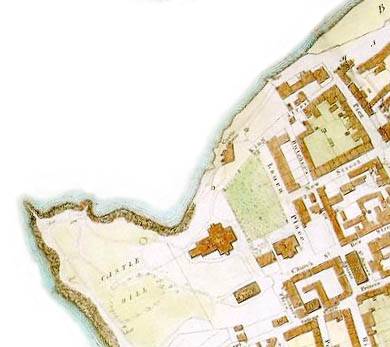
1st Building outside the town walls built - Sandmarsh Cottage. (At the end of Queens Rd)
Population about 1,750.
A wooden bridge, designed by John Nash, is erected.
Food Riots in Aberystwyth
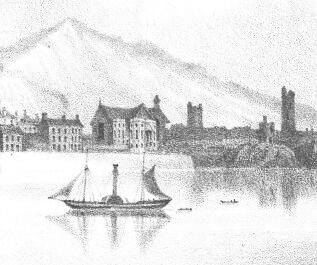
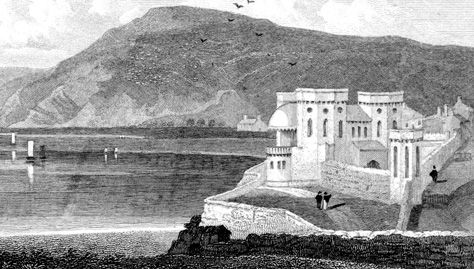
Completion of a small triangular villa called 'Castle House'
It was built for Sir Uvedale Price and designed by John Nash
just north-west of the castle ruins.
In 1864 the 'Castle Hotel' will be built around it, which will become the Old College in 1872
Napoleon Bonaparte leads French armies to numerous European wars
... this forces British tourists to explore local seaside towns like . . . Aberystwyth and the town goes though a growth spurt.
Snowfall so heavy that the sudden thaw sweeps away the bridge - and many others all over England and Wales
France invades Wales as a diversion from its plans to invade Ireland. The small invasion force capitulated the day after landing but caused widespread panic and denting Welsh support for the French Revolution
Work starts on a stone bridge, also designed by John Nash, to replace the one swept away the year before.
The first building to be built on the common marsh that is now called North Parade.
At this time the marsh frequently flooded, and the road rendered impassable for carts; so much so that women coming into market with their produce from Llanbadarn were forced to take a boat from the junction of Llanbadarn and Penglais Roads, and be rowed up to the foot of Great Dark Gate.
Part of the town wall was pulled down to make space for the expanding town in this case the building of Baker St.
New 'House of Correction Built'.
Bath House built on Bryn Diodde (on the prom, along from the bandstand, where there is now a shelter)
ABERYSTWITH
This is a sea-port town, situate in the Bay of Cardigan, and open to the Irish, or St. George's Channel. An immense number of company resort to this place, during the summer, for the benefit of sea-bathing; and it has several inns -- among which, the principal is the Talbot, where the accommodations are both extensive and genteel.At the extremity of the town, upon a point of land, stand the ruins of an ancient castle; of which little now remains but a solitary tower, overlooking the sea. It was rendered famous, by being at one time the residence of the great Cadwallader, and, in all the Welsh wars, was considered as a fortress of the first consequence; and, even so late as the civil wars of the last century, was esteemed a place of great strength.
"But the rich lead mines in its neighbourhood, were the basis of its glory. These mines are said to have yielded near a hundred ounces of silver from a ton of lead, and to have produced a profit of two thousand pounds a month. Here Sir Hugh Middleton made the vast fortune, which he expended afterwards on the New River, constructed for the purpose of supplying the northern side of London with water. But a gentleman of the name of Bushell, raised these mines to their greatest height. He was allowed by Charles the First the privilege of setting up a mint in this castle, for the benefit of paying his workmen. Here, therefore, all the business of the mines was transacted, which made Aberystwith Castle a place of more consequence and resort than any other in Wales. King Charles also appointed Mr. Bushell governor of the isle of Lundy; where he made a harbour for the security of his vessels; which carried the produce of his mines up the Severn. When the civil wars broke out, he had an opportunity of shewing his gratitude, which he did with the magnificence of a prince: he cloathed the King's whole army, and offered his Majesty a loan, which was considered as a gift, of forty thousand pounds. Afterwards, when Charles was pressed by the Parliament, Mr. Bushell raised him a regiment among his miners, at his own expence."
Mr. Price, whose estate of Foxley, in the county of Hereford, is mentioned in page 9, has recently finished a very pleasant house at Aberystwith; intended merely as a summer residence, for the benefit of sea-air and bathing; for which purposes, nothing could be more happily calculated. It is built upon rather a novel plan, close to the scite of the old castle, and so very near the sea, that, in spring-tides, its walls are literally washed by the waves; but that which would be objectionable in the winter, when the family never resort thither, is a recommendation to a spot which, in the summer, is fanned by the healthful sea-breeze, and embraces an uninterrupted view of the interesting variety constantly observable upon the bosom of the ocean, with the other exclusive advantages for which the situation was happily chosen.
In returning from Aberystwith, the ride may be varied, by taking a direction through the vale of Rhyddol --- which will afford an opportunity to the inquisitive traveller, of viewing the fine old church of Llanbadarn rendered an object of some curiosity, from its having formerly been a bishoprick: it is a very ancient structure, but without any vestige of ornament; and the situation is altogether pleasant. After skirting the river for about four miles through this delightful vale, the road ascends a steep woody mountain, and soon after joins the post-road to the Devil's Bridge along the beautiful terrace which has been already described.